Comparison of ARIMA and LSTM Models for Regional Export Values in Lampung Province
Article Sidebar
Main Article Content
Abstract
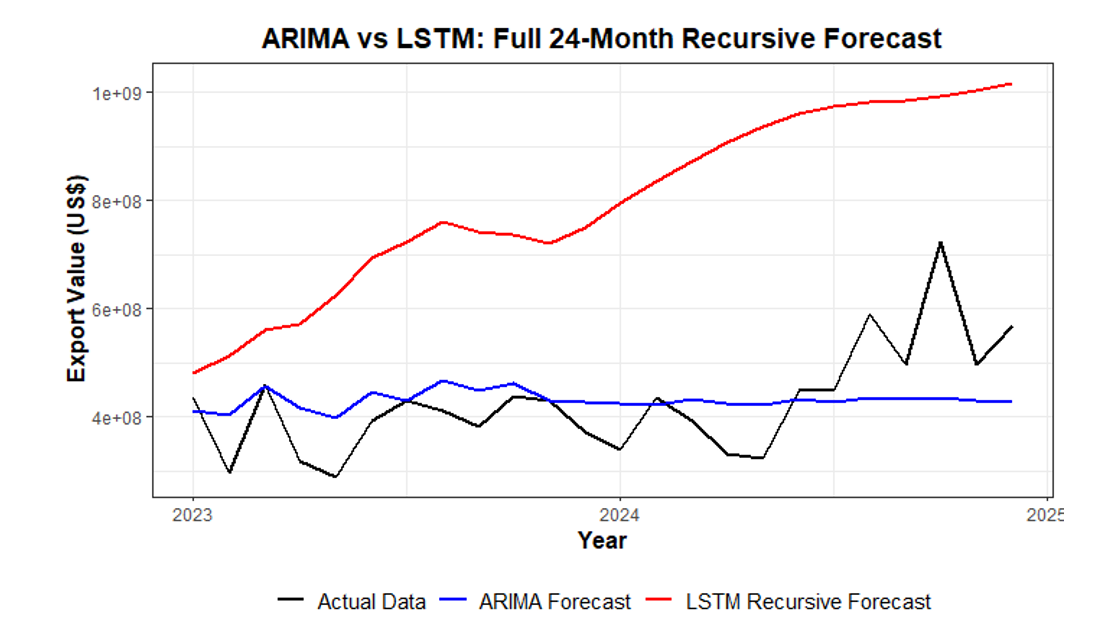
Accurate forecasting of regional export values is critical for effective macroeconomic planning. However, these indicators often exhibit complex volatility and structural shocks that challenge traditional frameworks. This study compares the forecasting performance of Autoregressive Integrated Moving Average (ARIMA) method against the machine learning architecture Long Short-Term Memory (LSTM), utilizing the monthly export values of Lampung Province. Data from January 2015 to December 2024 were partitioned into a training set (2015-2022) and testing set (2023-2024). For the linear approach, following Box-Cox transformation and first-order differencing, an ARIMA(1,1,0)(1,0,1)[12] model was fitted to the data based on Akaike Information Criterion (AIC) with comparison to other models of ARIMA. Simultaneously, an LSTM network was constructed using a 12-month lookback window and Min-Max scaling. The results indicate that the optimized ARIMA model achieved a lower Root Mean Squared Error (RMSE) of 94,030,344 compared to the LSTM network of 395,566,847 during the 24 months testing window. The ARIMA model effectively captured the underlying linear trends and stable annual seasonality without overfitting the training data. The study concludes that for moderately sized time series, ARIMA remains highly robust and can outperform complex machine learning architectures. Consequently, while neural networks offer advanced capabilities, classical frameworks should remain a primary tool for establishing baseline indicators in regional forecasting.
Article Details

This work is licensed under a Creative Commons Attribution-NonCommercial-ShareAlike 4.0 International License.
References
H. Bal, A. H. Mamun, S. Basher, M. R. Uddin, and M. Mowla, “Export-Led Growth Hypothesis in Developing Countries: Econometric Evidence from Bangladesh,” Omer Halisdemir Universitesi Iktisadi ve Idari Bilimler Fakultesi Dergisi, vol. 12, no. 4, pp. 454–465, Oct. 2019, doi: 10.25287/ohuiibf.507759.
N. M. Odhiambo, “Is export-led growth hypothesis still valid for sub-Saharan African countries? New evidence from panel data analysis,” EJMBE, vol. 31, no. 1, pp. 77–93, Feb. 2022, doi: 10.1108/EJMBE-06-2020-0156.
G. A. Ariwibowo, “Aktivitas Ekonomi dan Perdagangan di Karesidenan Lampung pada Periode 1856 hingga 1930,” PATANJALA, vol. 10, no. 2, p. 431, Sep. 2018, doi: 10.30959/patanjala.v10i2.361.
S. Hodijah and G. P. Angelina, “Analisis Pengaruh Ekspor Dan Impor Terhadap Pertumbuhan Ekonomi di Indonesia,” Mankeu, vol. 10, no. 01, pp. 53–62, Apr. 2021, doi: 10.22437/jmk.v10i01.12512.
R. J. Hyndman and G. Athanasopoulos, Forecasting: principles and practice, Third edition. Melbourne, Australia: OTexts, 2021.
G. E. P. Box, G. M. Jenkins, G. C. Reinsel, and G. M. Ljung, Time series analysis: forecasting and control, Fifth edition. in Wiley series in probability and statistics. Hoboken, New Jersey: Wiley, 2016.
D. Asteriou and S. G. Hall, Applied econometrics, 3. ed. London: Palgrave Macmillan, 2016.
S. Hochreiter and J. Schmidhuber, “Long Short-Term Memory,” Neural Computation, vol. 9, no. 8, pp. 1735–1780, Nov. 1997, doi: 10.1162/neco.1997.9.8.1735.
F. Chollet, Deep learning with Python, Second edition. Shelter Island: Manning Publications, 2021.
W. Bao, J. Yue, and Y. Rao, “A deep learning framework for financial time series using stacked autoencoders and long-short term memory,” PLoS ONE, vol. 12, no. 7, p. e0180944, Jul. 2017, doi: 10.1371/journal.pone.0180944.
D. M. Ahmed, M. M. Hassan, and R. J. Mstafa, “A Review on Deep Sequential Models for Forecasting Time Series Data,” Applied Computational Intelligence and Soft Computing, vol. 2022, pp. 1–19, Jun. 2022, doi: 10.1155/2022/6596397.
S. Siami-Namini, N. Tavakoli, and A. Siami Namin, “A Comparison of ARIMA and LSTM in Forecasting Time Series,” in 2018 17th IEEE International Conference on Machine Learning and Applications (ICMLA), Orlando, FL: IEEE, Dec. 2018, pp. 1394–1401. doi: 10.1109/ICMLA.2018.00227.
I. Magfirrah, M. Ilma, K. A. Notodiputro, Y. Angraini, and L. N. A. Mualifah, “Comparative Analysis of ARIMA and LSTM for Forecasting Maximum Wind Speed in Kupang City, East Nusa Tenggara,” Jambura J. Math, vol. 6, no. 2, pp. 169–175, Aug. 2024, doi: 10.37905/jjom.v6i2.25834.
N. Sunendar and Y. Rianto, “Comparison of ARIMA, LSTM, and GRU Models for Forecasting Sales of HIT Aerosol Products,” pilar, vol. 21, no. 2, pp. 153–159, Sep. 2025, doi: 10.33480/pilar.v21i2.6412.
W. A. Pratiwi, I. M. Sumertajaya, and K. A. Notodiputro, “Comparison of ARIMA, LSTM, and Ensemble Averaging Models for Short-Term and Long- Term Forecasting of Non-Stationary Time Series Data,” Inferensi, vol. 8, no. 3, p. 231, Nov. 2025, doi: 10.12962/j27213862.v8i3.22643.
F. A. Miranda, K. D. Tania, and R. D. Kurnia, “Comparative Performance Evaluation of ARIMA, SARIMA, and LSTM for Daily Shallot Price Forecasting in Palembang City,” Electronic. J. Edu. Soc. Econ. Tech., vol. 6, no. 2, p. 1323, Dec. 2025, doi: 10.33122/ejeset.v6i2.1323.
Y. N. Hilal, G. D. A. Nainggolan, S. H. Syahputri, and F. Kartiasih, “Comparison of ARIMA and LSTM Methods in Predicting Jakarta Sea Level,” J. Ilmu dan Teknologi Kelautan Tropis, vol. 16, no. 2, pp. 163–178, Oct. 2024, doi: 10.29244/jitkt.v16i2.52818.
A. I. E. Nensi, M. Al Maida, K. Anwar Notodiputro, Y. Angraini, and L. N. A. Mualifah, “Performance Analysis of ARIMA, LSTM, and Hybrid ARIMA-LSTM in Forecasting the Composite Stock Price Index,” CAUCHY, vol. 10, no. 2, pp. 588–604, Jun. 2025, doi: 10.18860/cauchy.v10i2.33379.
E. S. Putri and M. Sadikin, “Prediksi Penjualan Produk Untuk Mengestimasi Kebutuhan Bahan Baku Menggunakan Perbandingan Algoritma LSTM dan ARIMA,” FORMAT, vol. 10, no. 2, p. 162, Aug. 2021, doi: 10.22441/format.2021.v10.i2.007.
D. N. P. Pakaya, N. Achmad, I. K. Hasan, D. Wungguli, and S. N. Abdussamad, “Prediksi Wisatawan Mancanegara di Indonesia Menggunakan Metode SARIMAX dengan Efek Variasi Kalender Libur Nasional,” JRMM, vol. 4, no. 6, pp. 287–300, Jul. 2025, doi: 10.18860/jrmm.v4i6.34937.
S. Kwarteng and P. Andreevich, “Comparative Analysis of ARIMA, SARIMA and Prophet Model in Forecasting,” RD, vol. 5, no. 4, pp. 110–120, Oct. 2024, doi: 10.11648/j.rd.20240504.13.
Badan Pusat Statistik Provinsi Lampung, “Volume dan Nilai Ekspor.” Nov. 03, 2025. Accessed: Mar. 16, 2026. [Online]. Available: https://lampung.bps.go.id
G. E. P. Box and D. R. Cox, “An Analysis of Transformations,” Journal of the Royal Statistical Society Series B: Statistical Methodology, vol. 26, no. 2, pp. 211–243, Jul. 1964, doi: 10.1111/j.2517-6161.1964.tb00553.x.
D. A. Dickey and W. A. Fuller, “Distribution of the Estimators for Autoregressive Time Series With a Unit Root,” Journal of the American Statistical Association, vol. 74, no. 366, p. 427, Jun. 1979, doi: 10.2307/2286348.
R. H. Shumway and D. S. Stoffer, Time Series Analysis and Its Applications: With R Examples, 4th ed. 2017. in Springer Texts in Statistics. Cham: Springer, 2017. doi: 10.1007/978-3-319-52452-8.
P. J. Brockwell and R. A. Davis, Introduction to time series and forecasting, 3rd ed. in Springer texts in statistics. Switzerland: Springer, 2016.
M. A. Haris and P. R. Arum, “Negative Binomial Regression and Generalized Poisson Regression Models on the Number of Traffic Accidents in Central Java,” BAREKENG: J. Il. Mat. & Ter., vol. 16, no. 2, pp. 471–482, Jun. 2022, doi: 10.30598/barekengvol16iss2pp471-482.
D. C. Montgomery, C. L. Jennings, and M. Kulahci, Introduction to time series analysis and forecasting, Second edition. in Wiley series in probability and statistics. Hoboken, New Jersey: Wiley, 2015.
I. Goodfellow, A. Courville, and Y. Bengio, Deep learning. in Adaptive computation and machine learning. Cambridge, Massachusetts: The MIT Press, 2016.
Y. Hua, Z. Zhao, R. Li, X. Chen, Z. Liu, and H. Zhang, “Deep Learning with Long Short-Term Memory for Time Series Prediction,” IEEE Commun. Mag., vol. 57, no. 6, pp. 114–119, Jun. 2019, doi: 10.1109/MCOM.2019.1800155.
V. Cerqueira, L. Torgo, and I. Mozetic, “Evaluating time series forecasting models: an empirical study on performance estimation methods,” Mach Learn, vol. 109, no. 11, pp. 1997–2028, Nov. 2020, doi: 10.1007/s10994-020-05910-7.
D. K. Sharma, M. Chatterjee, G. Kaur, and S. Vavilala, “Deep learning applications for disease diagnosis,” in Deep Learning for Medical Applications with Unique Data, Elsevier, 2022, pp. 31–51. doi: 10.1016/B978-0-12-824145-5.00005-8.