Implementation of the Haversine Algorithm in the Development of a WebGis
Article Sidebar
Main Article Content
Abstract
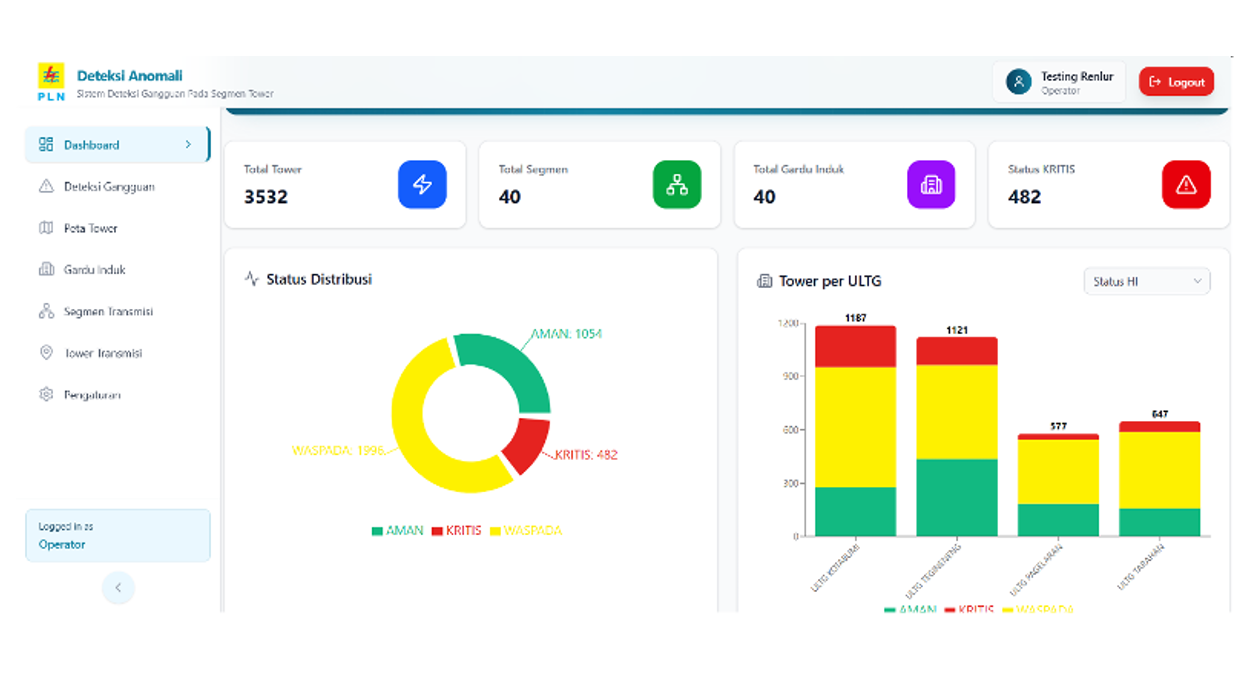
Monitoring transmission tower disruptions require a system capable of presenting location information accurately and quickly to support the decision-making process. Limitations in the presentation of spatial data and the manual process of identifying disruption locations pose obstacles to improving the effectiveness of network infrastructure management. This study aims to develop a web-based transmission tower disruption monitoring system that integrates geospatial visualization and distance calculations to determine the nearest tower. The system is built using web technology with digital map support to display tower locations and disruption points interactively. Backend testing results using k6 show that all endpoints have a 100% success rate without failure, with response times ranging from 1.73 ms to 4430 ms, with the majority being below 1000 ms. All response values are still within the tolerance limit (<5000 ms), indicating stable system performance in handling various types of requests. In addition, the results of User Acceptance Testing (UAT) show that all system modules run according to user requirements.
Article Details

This work is licensed under a Creative Commons Attribution-NonCommercial-ShareAlike 4.0 International License.
References
Nurhawa, N. T. Yani, H. Asadurrahman, and B. Bonanza, “Pemanfaatan Sistem Informasi Manajemen Untuk Meningkatkan Efisiensi Operasional Perusahaan,” JUKONI: Jurnal Ilmu Ekonomi dan Bisnis, vol. 3, no. 1, Oct. 2026.
Y. Cahyaningrum and Y. Sambharakreshna, “Optimization of Web-Based Asset Management to Increase Efficiency and Sustainability,” Journal of Information Technology and Computer Science (INTECOMS), vol. 7, no. 2, 2024.
K. M. Azam and M. Arifin, “Penerapan Sistem Informasi Manajemen Aset Berbasis Web Menggunakan Qr Code pada CV Asa Mulia,” Jurnal Akademik Pengabdian Masyarakat, vol. 3, no. 2, pp. 144–148, 2025, doi: 10.61722/japm.v3i2.4137.
M. J. Nur, M. I. Mattalitti, and R. G. Ahmad, “Tata Kelola Aset Barang Milik Daerah Berbasis E-BMD Pada Dinas Pertanian Kota Kendari,” Journal Publicuho, vol. 7, no. 3, pp. 1752–1766, Oct. 2024, doi: 10.35817/publicuho.v7i3.546.
N. Masruroh, A. P. Ramadhani, RB. A. Maulana, and A. Sy. K. Widad, “Edukasi Sistem Informasi Validasi Aset Untuk Peningkatan Efisiensi Pengelolaan Aset Daerah,” JAMAS: Jurnal Abdi Masyarakat, vol. 3, Feb. 2025.
S. Wahono and H. Ali, “Peranan Data Warehouse, Software Dan Brainware Terhadap Pengambilan Keputusan (Literature Review Executive Support Sistem For Business),” JEMSI: Jurnal Ekonomi Manajemen SIstem Informasi, vol. 3, no. 2, Dec. 2021, doi: 10.31933/jemsi.v3i2.
I. S. Meidodga, A. Syahrin, R. T. Putra, F. Warfandu, and A. N. Bimasena, “Pemanfaatan Data Geospasial Dalam Mewujudkan Sistem Informasi Pertanahan Multiguna Bagi Multipihak,” Jurnal Widya Bhumi, vol. 3, no. 1, Jul. 2023.
M. P. Trianjani, S. Alam, and M. Ashdaq, “Implementasi Algoritma Analisis Hotspot dengan Kernel Density Estimation (KDE) untuk Visualisasi Bisnis UMKM Kuliner Berbasis WebGIS (Studi Kasus: Kota Makassar),” RIGGS: Journal of Artificial Intelligence and Digital Business, vol. 4, no. 4, pp. 12743–12750, Jan. 2026, doi: 10.31004/riggs.v4i4.4949.
S. K. Hidayat, “Sistem Integrasi IoT dan GIS Untuk Optimalisasi Respons Distribusi Bantuan Bencana di Daerah Terpencil,” J. Comput. Sci. Technol., vol. 5, Nov. 2025.
R. Herwanto, F. Susanto, R. Dwi, M. H. Prayoga, R. M. Dinata, and Wamiliana, “Haversine Geo-Spasial Data Android Model Untuk Optimasi Rute Kebersihan Lingkungan Terdekat,” Jurnal Pepadun, vol. 5, no. 1, 2024.
E. Purwanto and Gunadi, “Implementasi Metode Haversine Formula pada Otomasi Registrasi Pelanggan Layanan Internet Berbasis Web,” Technologica, vol. 5, no. 1, pp. 185–197, Jan. 2026.
A. Purnomo and R. Hartono, “Analisa Waktu Respon pada Metode Pengukuran Jarak pada Sistem Informasi Geografi,” Jurnal Teknologi Informasi dan Ilmu Komputer, vol. 12, no. 1, pp. 39–46, Feb. 2025, doi: 10.25126/jtiik.2025128690.
idzoh Hasanah, A. Suharso, J. HSRonggo Waluyo, T. Timur, and J. Barat, “Algoritma Haversine pada Sistem Informasi Geografis: Tinjauan Literatur Sistematis,” Jurnal Nuansa Informatika, vol. 17, pp. 2614–5405, Jul. 2023, [Online]. Available: https://journal.fkom.uniku.ac.id/ilkom
A. M. Abdillah, Rianto, and N. I. Kurniati, “Penerapan Metode Haversine pada Aplikasi Layanan Perbaikan Kendaraan Berbasis Location Based Service,” JUITA: Jurnal Informatika, vol. 7, no. 2, pp. 81–91, Nov. 2019.
A. Hamzah, I. Haryadi, K. Rizkyandra, and I. Supriadi, “Sistem Monitoring Kerusakan Jalan Di Kota Bandung Berbasis Sistem Informasi Geografis (Studi Kasus: Kota Bandung),” Jurnal Ilmiah ILKOMINFO - Jurnal Ilmu Komputer dan Informatika, no. 1, pp. 2621–4962, Jan. 2025.
M. D. A. Kurniawan, Indera, Handoyo, and Ruki, “Implementasi Sistem Informasi Aset Berbasis Web GIS pada PT. PLN ULP Pringsewu,” EXPERT: Jurnal Manajemen Sistem Informasi dan Teknologi, vol. 15, no. 1, p. 98, Jun. 2025, doi: 10.36448/expert.v15i1.4272.
N. Kurniadin, F. V. A. S. Prasetya, P. K. S. Hadi, and W. Feri, “Pemanfaatan Sistem Informasi Geografis Berbasis Web (WebGis) untuk Pemetaan Asset Lahan dan Bangunan Politani Samarinda,” Jurnal Sains Informasi Geografi, vol. 6, no. 1, p. 20, May 2023, doi: 10.31314/jsig.v6i1.1359.
S. Arba’i, A. Wedhasmara, Fathoni, A. Putra, and D. Kurniawan, “Sistem Informasi Geografis Pemetaan Menara Telekomunikasi dengan Pengecekan Jarak Menggunakan Metode Haversine,” Jurnal Teknik Informatika dan Sistem Informasi, vol. 9, no. 3, Jan. 2023, doi: 10.28932/jutisi.v9i3.6219.
H. L. H. Adhani, M. A. Bianto, A. N. Pratama, and S. A. Hidayah, “Implementasi Sistem Pemesanan Hotel Menggunakan Algoritma Haversine untuk Optimalisasi Rekomendasi Lokasi,” Jurnal Informatika Terpadu, vol. 11, no. 2, pp. 98–107, Oct. 2025, [Online]. Available: https://journal.nurulfikri.ac.id/index.php/JIT
F. A. Setiawan, F. S. Rezkiadi, R. Hardiansyah, S. Sekira, M. R. Fahlevvi, and A. Apriyansa, “Integrasi Big Data Dan Sistem Informasi Geospasial Untuk Meningkatkan Ketahanan Pangan Di Indonesia,” Data Sciences Indonesia (DSI), vol. 5, no. 1, pp. 105–118, Jul. 2025, doi: 10.47709/dsi.v5i1.6287.
A. Ginting, E. P. Bangun, K. B. Putba, S. Wahyuni, E. N. Pasaribu, and O. Bangun, “Studi Analisis Model Waterfall pada Pengembangan Sistem Informasi,” Jurnal Nirta: Studi Inovasi, vol. 5, p. 2026, 2026, [Online]. Available: https://ejournal.nlc-education.or.id/index.php/JNSI/issue/view/34
R. S. Pressman, Software Engineering: A Practitioner’s Approach, 5th ed. McGraw-Hill, 2001.
N. B. Ruparelia, “Software development lifecycle models,” ACM SIGSOFT Software Engineering Notes, vol. 35, no. 3, pp. 8–13, May 2010, doi: 10.1145/1764810.1764814.
A. A. Aziiza and A. N. Fadhilah, “Analisis Metode Identifikasi dan Verifikasi Kebutuhan Non Fungsional,” Applied Technology and Computing Science Journal, vol. 3, no. 1, Jun. 2020.
A. E. Kumala, I. Borman, P. Prasetyawan, A. Dinas, P. Dan, and K. Hewan, “Sistem Informasi Monitoring Perkembangan Sapi di Lokasi Uji Performance (Studi Kasus: Dinas Peternakan dan Kesehatan Hewan Provinsi Lampung),” Jurnal TEKNOKOMPAK, vol. 12, no. 1, pp. 5–9, 2018.
E. I. Azzahrah, F. Amalia, and F. Ramdani, “Pengembangan Sistem Pelaporan Daerah Pasca Bencana Menggunakan WEBGIS (Studi Kasus Badan Penanggulangan Daerah Pasca Bencana Daerah, Kabupaten Ponorogo),” Jurnal Pengembangan Teknologi Informasi dan Ilmu Komputer, vol. 5, no. 6, pp. 2141–2151, May 2021, [Online]. Available: http://j-ptiik.ub.ac.id
H. Y. Ardhi, A. Muhidin, and T. N. Wiyatno, “Implementasi Sistem Basis Data Terintegrasi pada Aplikasi Dashboard Monitoring Replikasi Bank Tabungan Negara Metode Prototype,” MALCOM: Indonesian Journal of Machine Learning and Computer Science, vol. 5, no. 3, pp. 942–952, Jul. 2025, doi: 10.57152/malcom.v5i3.2049.
K. A. B. W. Kesuma, I. N. Y. A. W. Wijaya, and I. G. J. E. P. Putra, “Implementasi Next.Js, Typescript, Dan Tailwind Css Untuk Pengembangan Aplikasi Frontend Sistem Inventory Perusahaan Apar (Studi Kasus: CV Indoka Surya Jaya),” JIKOM: Jurnal Informatika dan Komputer, vol. 14, no. 2, pp. 95–108, Aug. 2024.
W. P. Sari, H. I. Ayuningtyas, B. Bahari, T. A. A. Prayoga, and P. S. Ramdhani, “Pengembangan sistem informasi geografis untuk pemetaan bangunan gedung pemerintah di kota Bandung,” IT-Explore: Jurnal Penerapan Teknologi Informasi dan Komunikasi, vol. 4, no. 3, pp. 258–271, Oct. 2025, doi: 10.24246/itexplore.v4i3.2025.pp258-271.
V. Hosal, H. Angriani, and A. Muawwal, “Implementasi Software Testing Dalam Quality Assurance pada Learning Management System Website Classes,” Jurnal Ilmu Komputer Kharisma Tech, vol. 16, Sep. 2021, [Online]. Available: https://tech.kharisma.ac.id
Aliyah, N. Hartono, and A. A. Muin, “Penggunaan User Acceptance Testing (UAT) Pada Pengujian Sistem Informasi Pengelolaan Keuangan Dan Inventaris Barang,” Switch: Jurnal Sains dan Teknologi Informasi, vol. 3, no. 1, pp. 84–100, Mar. 2025, doi: 10.62951/switch.v3i1.330.