A Scheduling Model for Balancing the Workload at Supermarket X Using Integer Programming
Article Sidebar
Main Article Content
Abstract
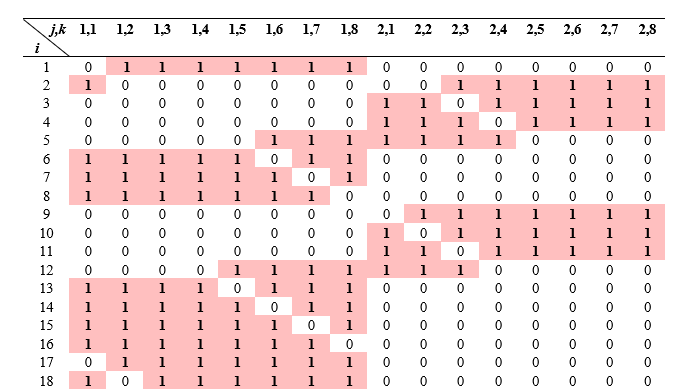
Employee scheduling is an important operational problem in the retail industry, as it affects both workforce efficiency and workload balance. This study aims to develop an employee scheduling model for Supermarket X using an integer programming approach based on simulated data. The model considers two work shifts, 42 employees, and an eight-day scheduling period, with decision variables representing work assignments and days off. Several operational constraints are included, such as minimum staffing requirements, one-shift-per-day restrictions, and limitations on the number of employees off on the same day. The model is solved using LINGO software. The results show that each employee is assigned seven working days and one rotating day off, while all constraints are satisfied. These results indicate that integer programming is an effective method for generating balanced and feasible employee schedules in retail operations.
Article Details

This work is licensed under a Creative Commons Attribution-NonCommercial-ShareAlike 4.0 International License.
References
M. L. Pinedo, "Scheduling: Theory, Algorithms and Systems," 6th Edition, Springer Nature, 2022.
T. H. Sitorus and H. L. Siagian, "Pengaruh Beban Kerja dan Fleksibilitas Kerja Terhadap Kepuasan Kerja dengan Motivasi sebagai Pemediasi," Journal of Media, Sciences, and Education, vol. 2, no. 3, pp. 107-118, 2023, doi: 10.36312/jomet.v2i3.41.
R. Q. Alhilwa and Y. B. Kusuma, "Peranan Manajemen Operasional dalam Meningkatkan Kinerja Perusahaan Ritel di PT Tsamaniya Amanah Mandiri," Jurnal Penelitian Ilmu-Ilmu Sosial, vol. 1, no. 12, pp. 390-395, 2024, doi: 10.5281/zenodo.12786728.
D. Rachmawati and Syahrinullah, "Analisis Manajemen Operasional dalam Meningkatkan Kualitas Layanan Pelanggan pada Warung Madura di Purwokerto," Journal of Management Branding, vol. 1, no. 2, 118-128, 2024, doi: 10.71326/jmb.v1i2.43.
I. Irsyad, M. R. Katili, and N. Achmad, "Penerapan Metode Integer Linear Progamming pada Penjadwalan Karyawan," Jurnal Riset dan Aplikasi Matematika, vol. 4, no. 1, pp. 63-73, 2020, doi: 10.26740/jram.v4n1.p63-73.
M. Widyaningsih, "Optimasi Penjadwalan Jumlah Perawat dengan Menggunakan Linear Programming," Jurnal Bisnis dan Manajemen, vol. 18, no. 2, pp. 39-56, 2018, doi: 10.20961/jbm.v18i2.26674.
E. Safitri, S. Basriati, R. E. Putri, "Optimasi Penjadwalan Perawat Menggunakan Integer Linear Programming (Studi Kasus: RS. Aulia Hospital Pekanbaru)," Jurnal Fourier, vol. 10, no. 1, pp. 45-56, 2021, Retrieved from https://fourier.or.id/index.php/FOURIER/article/view/113.
D. S. Anggraini, S. Syarifuddin, and Q. Q. A'yun, "Optimasi Penjadwalan Menggunakan Pemograman Linear Integer pada Masalah Penjadwalan Perawat pada UPT Dinas Kesehatan Puskesmas Jonggon Jaya," BASIS: Jurnal Ilmiah Matematika, vol. 3, no. 1, pp. 54-60, 2024., Retrieved from http://jurnal.fmipa.unmul.ac.id/index.php/Basis/article/view/1279/607.
D. M. Warner, "Scheduling Nursing Personnel According to Nursing Preference: A Mathematical Programming Approach", Operations Research, vol. 24, no. 5, pp. 842-856, 1976, doi: 10.1287/opre.24.5.842.
D. Lalang, E. Sinu, and J. Kasim, "Optimasi Penjadwalan Shift Perawat Ruang Sel Anak dengan Metode Goal Programming di RSD Kalabahi," Transformasi: Journal of Economics and Business Management, vol. 1, no. 4, pp. 193-205, 2022, doi: 10.56444/transformasi.v1i4.290.
M. N. Azaiez and S. S. Al Sharif, "A 0-1 goal programming model for nurse scheduling," Computers and Operations Research, vol. 32, no. 3, pp. 491-507, 2005, doi: 10.1016/S0305-0548(03)00249-1.
S. Gupta S. Sinha, "Academic Staff planning, allocation and optimization using Genetic Algorithm under the framework of Fuzzy Goal Programming," Procedia Computer Science, vol. 172, pp. 900-905, 2020, doi: 10.1016/j.procs.2020.05.130.
Z. Fourati, S. Smaoui, and H. Kamoun, "An Integrated Lexicographic Goal Programming and Dynamic Satisfaction Function Model for Effective Nurse Scheduling," Decision Analytics Journal, vol. 9, 100349, 2023, doi: 10.1016/j.dajour.2023.100349.
I. Rizany, H. Handiyani, H. Pujasari, D. Erwandi, and C. I. Wulandari, "Self-scheduling for nurse: A concept analysis," Multidisciplinary Reviews, vol. 8, no. 1, e2025021, 2025, doi: 10.31893/multirev.2025021.
A. W. Stimpfel, K. Leep-Lazar, M. Mercer, and K. DeMarco, "Scheduling is Everything: A Qualitative Descriptive Study of Job and Schedule Satisfaction of Staff Nurses and Nurse Managers," Western Jornal of Nursing Research, vol. 47, no. 10, pp. 912-923, 2025, doi: 10.1177/01939459251330280.
B. Oner, F. Cokelek, N. Caliskan, and S. Duygulu, "Risks Posed by Nurses' Working Hours in the Intensive Care Unit: A Systematic Review," BMC Nursing, 24, 1319, 2025, doi: 10.1186/s12912-025-03983-0.
J. Soriano, E. E. Jalao, and I. A. Martinez, "Integrated Employee Scheduling with Known Employee Demand, Including Breaks, Overtime, and Employee Preference," Journal of Industrial Engineering and Management, vol. 13, no. 3, pp. 451-463, 2020, doi: 10.3926/jiem.3126.
S. Y. Ang, S. N. A. M. Razali, and S. L. Kek, "Optimized preference of security staff scheduling using integer linear programming approach," An International Journal of Advanced Computer Technology, vol. 8, no. 4, pp. 3103-3111, 2024, Retrieved from https://ijact.in/index.php/j/article/view/488.
A. Brun, E. Feron, S. Alam, and D. Delahaye, "Schedule optimization and staff allocation for airport security checkpoints using guided simulated annealing and integer linear programming," Journal of Air Transport Management, vol. 124, 102746, 2025, doi: 10.1016/j.jairtraman.2025.102746.
S. Agrali, Z. C. Taskin, and A. T. Unal, "Employee scheduling in service industries with flexible employee availability and demand," Omega, vol. 66, part A, pp. 150-169, 2017, doi: 10.1016/j.omega.2016.03.001.
L. Mandasari, "Analisis Kemampuan Pemecahan Masalah Mahasiswa Pendidikan Matematika Pada Mata Kuliah Pemodelan Matematika," Jurnal As-Salam, vol. 2, no, 2, pp. 68-75. 2018, doi: 10.37249/as-salam.v2i2.35.
L. G. Dwikasari, S. Pawestri, and R. Z. Rasyda, "Pemodelan Matematika dalam Optimasi Laba Produksi Olahan Rumput Laut di UD Harkat Makmur," Jurnal Kolaboratif Sains, vol. 7, no. 6, pp. 1942-1953, 2024, doi: 10.56338/jks.v7i6.5371.
Y. Tang, S. Agrawal, and Y. Faenza, "Reinforcement learning for integer programming: Learning to Cut," ICML'20: Proceedings of the 37th International Conference on Machine Learning, article 868, pp. 9367-9376, 2020.
H. Nufus, and Taufiq, "Penjadwalan Pekerjaan pada Manajemen Waktu dan Sumber Daya Menggunakan Algoritma Greedy," Jurnal Sains Dan Teknologi 4.0, vol. 1, no. 2, pp. 53-59, 2024.
W. Tahir, D. Wungguli, and M. R. F. Payu, "Optimasi Penjadwalan Waktu Kerja Menggunakan Integer Programming," EULER: Jurnal Ilmiah Matematika, Sains dan Teknologi, vol. 7, no. 2, pp. 51-55, 2019, doi: 10.34312/euler.v7i2.10343.
N. S. Kurnia, D. Septiawan, and N. F. Anggraeni, "Analisis Masalah Transhipment Menggunakan Software Lingo di PT. SBT," Jurnal Ilmiah Teknologi Infomasi Terapan, vol. 6, no. 2, pp. 94-99, 2020, doi: 10.33197/jitter.vol6.iss2.2020.369.